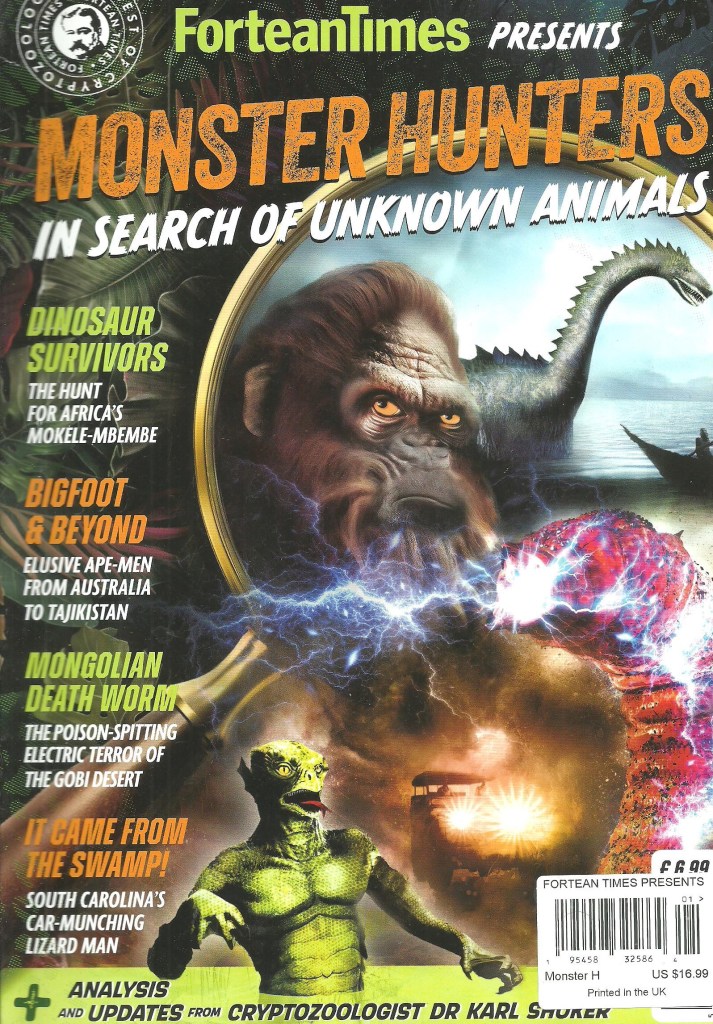
I normally wouldn’t review a magazine here, but it’s been a while since I’ve updated this blog (Let’s have more books on cryptids, Publishing Industry!) and, besides, Monster Hunters: In Search of Unknown Animals (Fortean Times; 2023) isn’t just a magazine; rather Dr. Karl Shuker continually refers to it as a “bookazine” in his introduction to the collection of articles from the Fortean Times.
Zoologist, cryptozoologist and author Shuker, who writes Fortean Times‘ regular “Alien Zoo” feature, pens an introduction and offers commentary at the end of each of the publication’s dozen pieces. A sort of “best of” issue, Monster Hunters offers past Fortean Times features on various cryptids, ranging from the best-known (Bigfoot, The Loch Ness Monster, the Yeti, the Yowie, the Mongolian Death Worm) to more obscure (“Trunko”, the guls of Tajikistan and the Nandi Bear) and a few in between those extremes.
These range in format as well, from Martin Gately’s memoir-like article about his childhood visit to Loch Ness in 1977, in which he was hopeful of seeing the monster for himself, as unlikely as that actually was, to more traditional travelogue-like investigations, like Adam Davies’ journeys to the Congo in search of the legendary living dinosaur mokele-mbembe and to the Gobi desert for the death worm and Richard Freeman and company’s trip to a remote valley in Tajikistan to find a strange, sexually aggressive apeman known as a gul. There are even a few “armchair” investigations, like Neil Arnold’s piece on lions in the United Kingdom and Richard Svensson’s piece on Lindorms, giant snakes of Swedish legend.
My two favorite pieces were probably those by Shuker himself.
The first of these is on “Trunko”, a huge, bizarre creature that washed ashore on the South African coast in 1924 after a battle with a pair of killer whales, an animal said to be 47-feet long, covered in long white hair and having where its head might be assumed to be a five-foot long, elephant like trunk. Shuker gave it its name in his 1996 book The Unexplained, and, apparently it stuck.
Shuker reexamines the tale of Trunko as it was originally told, and, along with Markus Hemmler, comes to a conclusion regarding the sea monster’s identity , based on a trio of unpublicized photos the pair discovered in 2010. The creature was actually nothing more than a “globster,” one of the “huge, amorphous, hairy masses” that are, rather than the monsters they apparently seem, merely a “tough skin-sac of blubber containing collagen (and occasionally an isolated bone or two) that is sometimes left behind when a whale dies and its skull and skeleton have separated from the skin and sunk to the sea bottom.” The orcas seen fighting it before it washed ashore were more likely playing with the otherwise inert mass.
It’s the rare piece of writing on cryptozoology that provides an answer to the question of a creature’s existence, even if it is here in the negative
The other Shuker piece is on the ever intriguing Nandi bear of Kenya, a “composite creature ‘created’ from the erroneous lumping together of reports describing several taxonomically discrete animals,” including “all-black ratels (honey badgers)…some form of extra large baboon…spotted hyaenas…and/or a supposedly long-extinct lion-sized relative called the short-faced hyaenea…the aardvark…perhaps even a relict true bear…and, most fascinating of all, a putative surviving chalicothere.” A chalicothere, by the way, is a weird mammal that went extinct in the early Pleistocene; they had horse-like heads and roughly ape-shaped bodies, with long, clawed forearms that separated them from most other ungulates.
Specifically, he wonders if perhaps a captive Nandi bear was once exhibited in Britain. He takes as clues to this possibility a few bits of research offered by the late Clinton Keeling, an author who found historical notices of strange, unidentified animals, including one from the 1730s of a “young HALF and HALF; the head of a Hyena, the hind part like a Frieseland [Polar?] Bear”, and a more intriguing still ad from 1875 promising “Indian Prairie Fiends”, described thusly: “Most Wonderful creatures. Head like the Hippopotamus. Body like a Bear. Claws similar to the Tiger, and ears similar to a Horse.”
Keeling thought this may describe a chalicothere, sightings of some late-surviving population of which could be the origin of the Nandi bear legend (he noted that this particular menagerie was not always exact about the source of its specimens, which might explain why an African animal was referred to as an “Indian Prairie Fiend.”)
Shukar offers another, still more intriguing possibility. What if the “Indian Prairie” weren’t that of North America, but instead South America? Could these “fiends” actually refer to sizable ground sloths, which, after all, seem to fit that description even better than a chalicothere (and, it’s worth noting, sound very different from the “HALF and HALF” cryptid mentioned in the first notice).
Also of note in the “bookazine” are it’s skeptical takes on two American cryptids, Bigfoot, covered in a thorough but highly readable reexamination of the famous Patterson/Gimlin film by Stu Neville that mentions some of the inconsistencies surrounding the story of the film, and the Lizard Man of Scape Ore Swamp, which basically takes down the original sighting of the large reptile man by the late Christopher Davis in 1988.
All told, it’s a fun, intriguing look at the state of modern cryptozoology, through the prism of the one magazine that seems to cover the subject with some regularity.
 Monsters of Ohio