Review: “Unnatural Ohio”

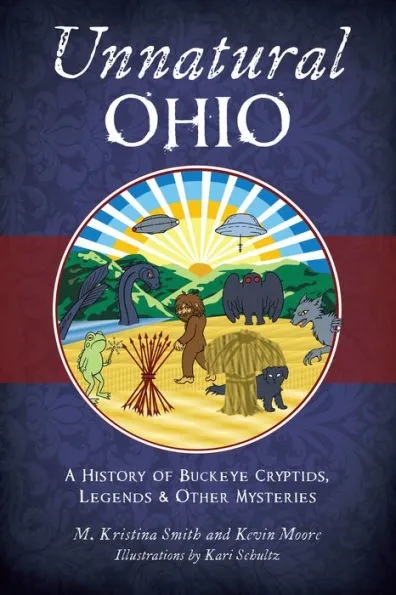
Unnatural OhioA good one-third of Unnatural Ohio: A History of Buckeye Cryptids, Legends & Other Mysteries (The History Press; 2023) should be particularly appealing to those with an interest in the monsters of Ohio. The book, by Rutherford B. Hayes Presidential Library and Museums employees M. Kristina Smith and Kevin Moore, is an expansion and extrapolation of a 2020 special exhibit entitled Ohio: An Unnatural History, and is divided into three sections: Buckeye Cryptids, Ghostly Tales and UFOs and Mysteries of the Sky.

Actually, chances are that most readers will find more than just one section of interest. After all, if you’re interested in one aspect of the paranormal, chances are you’re interested in others…and certainly some blend into each other (As in the case of Mothman, for example, a maybe flesh-and-blood creature that nevertheless intersects with UFO lore). I myself am obviously a monster guy, but I also enjoy reading about UFOs. Ghosts? Not so much. I’m just not a believer.

And, as the writers point out, about “two in every three people reading this will likely believe in at least one of the supernatural Ohio legends we cover,” citing statistics on belief in the paranormal.

In the cryptid section that kicks off the book, the writers focus on six different monsters (all of which are also covered at length in Monsters of Ohio): Bigfoot (they mention the Norwalk Ape, the name “The Grassman” and the Gallipolis Gorilla all in passing), The Loveland Frog, The Defiance Wolfman (which they call “The Dogman of Defiance,” dogmen being more popular than wolfmen at the moment), The Lake Erie Monster, The Melonheads and Mothman.

The writers have a citation heavy, reporterly style that reads with some authority, and there is a very thorough bibliography, allowing the unusually curious to check their work…or to check out more on the subjects (Familiar books like Loren Coleman and company’s 2006 Weird Ohio, James Renner’s 2012 It Came From Ohio, Michael Newton’s 2013 Strange Ohio Monsters and Chad Arment’s 2019 The Historical Bigfoot all appear here).

In addition to relying on newspaper accounts and other books, however, the pair also conduct interviews seemingly everywhere that it’s both beneficial and feasible to do so. Therefore, on the subject of the Wolfman/Dogman of Defiance, they track down a former reporter from the Defiance Crescent-News, which extensively covered the sightings, to ask what he remembers of that time in the 1970s, and cryptozoological writer Lyle Blackburn, about how it compares to other dogman sightings.

This approach is especially welcome when it comes to the Loveland Frog, given how cloudy the story has been over the years, with the main witnesses in the 1972 sighting alternately refusing to talk and changing the account over the years. It remains cloudy, but every fact that can be caught and nailed down seems to be there, including taking the story right up into the modern day, by chronicling the almost-certainly-a-hoax 2016 sighting and the several ways in which Loveland has embraced the legend (Nowhere near as thoroughly as Point Pleasant has embraced the Mothman legend, however; Loveland could certainly use a statue).

As a writer who has covered this same beat in the past, I was most intrigued by their section on the Lake Erie Monster, which they refer to as South Bay Bessie, as it included reports I had never heard of, like one 1912 report in which Kelleys Island residents apparently saw the monster struggling to break through the ice on the frozen lake. There is also more thorough reporting on the former mayor of Milan’s sighting of the monster in the Huron River (this is the one where the monster is described as having both horns and tentacles…both, it seems from the reporting here, on its head).

Part two of the books, that on ghosts, seems to be the slightest, and understandably so: There is so much writing on ghosts in Ohio that it seems all of the stories have been told, re-told and re-re-told. Here they cover “The Elmore Rider,” a headless motorcyclist; Gore Orphanage near Vermillion, which they contend never actually existed, but they track down the stories that lead to the urban legend about it; the legend of Holcomb Woods in east of Bowling Green and a handful of maritime legends, including one of a black dog of ill portent and the supposed Lake Erie Triangle.

Most of these were new to me, although, as I said, I don’t generally pay too much attention to ghost stories, and the books I’ve read on Ohio ghosts I mainly did so looking for monsters tucked in between the ghost stories.

Finally, part three includes a trio of stories that may or may not have something to do with extraterrestrials, all three of which are fairly familiar from the extant literature: The 1966 Portage County UFO chase, in which many police officers saw and gave chase to a UFO; the “WOW!” signal, the OSU “Big Ear” radio telescope’s reception of what seemed to be a “scream” of some sort in the data they regularly received; and the 1973 Coyne UFO incident, in which a helicopter flying from Columbus to Cleveland had a close encounter, being forced to dodge a UFO that seemed intent on ramming them.

Again the pair’s reporterly thoroughness is apparent in these oft-told tales and it is quite welcome. I’ve flirted with the idea of embarking on a book about UFOs in Ohio’s airspace before, but, after reading this section, I’m not so sure it’s even worth doing. For example, after reading their reporting on the Portage County chase, its investigation and its aftermath, I can’t imagine there’s anything left to add.

The book is rather fully illustrated, both by photographs of relevant areas (usually not very compelling images of landscapes and forest paths, sections of road or bridges), and pencil illustrations of the cryptids by artist Kari Schultz (Sadly no image of Mothman, though; he’s represented by a photo of the statue).

Schultz also seems responsible for the cover, in which the great seal of Ohio is crowded with cryptids, including the  black  dog from the ghostly tales section and the specific UFOs from the Portage County and Coyne incidents (I have a t shirt that similarly paired the seal with the paranormal, a much more simple design showing Bigfoot, in the classic “Patty” pose, striding between the bundles of arrows and grains).

One could claim the writers are trying to do too much with their book, tackling three very big subjects as they do, but they basically choose a handful of stories from each of those subjects, and try to unravel the legends into their component stories. It is therefore a good starting point for each of the three subjects and, in some cases, they seem to tell the definitive stories of the stories, like the aforementioned Portage County UFO chase.
Review: “Adventures in Cryptozoology”

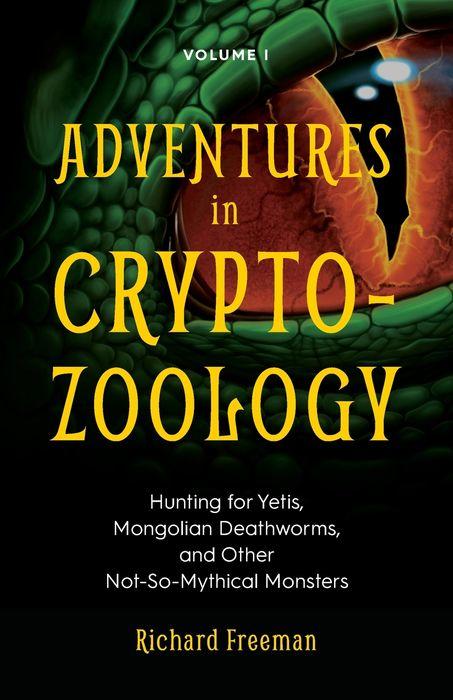
adventures in crytpozoologyRichard Freeman’s Adventures in Cryptozoology: Hunting for Yetis, Mongolian Deathworms, and Other Not-So-Mythical Monsters (Mango; 2019) takes the familiar, survey-like approach to the undiscovered animals that make up the world of cryptozoology, not unlike Bernard Heuvelmans did in his landmark 1955 book On The Track of Unknown Animals.

In five of his six chapters, Freeman breaks up the mystery menagerie into several broad categories—Dragons, Lake Monsters, Sea Monsters, Giant Apes and Hominins and  the intriguingly-named “The Magic Zoo”—and he then details sightings and examines evidence of each in a region by region tour of the subject. As for the other chapter, that is the first in the book, and it details the history of cryptozoology, including a generous section devoted to many of the field’s leading lights and lesser-known participants throughout that history.

The discussions of water monsters and giant apes and hominins will include many instances and anecdotes familiar to readers of past cryptozoological works, but the dragons section is particularly interesting. Freeman’s definition of a dragon is a wide one, and while there are a few sightings of animals that seem straight out of medieval legend, complete with fire breath, there are also discussions of outsized lizards and what might be relict Pterosaurs…anything that might be mistaken for a dragon, basically.

In “The Magic Zoo” chapter, Freeman explores various legendary animals once thought to exist—unicorns, griffons, basilisks, the fire-resistant salamander—and a couple of famous creatures of cryptozoology, the colorfully-named Mongolian deathworm and the tatzelwurm. He also tackles the 18th century mystery killer known as “The Beast of Gévaudan,” which he quite confidently identifies as a sub-adult male lion, likely escaped from a wealthy person’s personal menagerie.

The first installment of a two-volume series—the second volume, In Search of Real Monsters, was just released this January—Freeman’s Adventures in Cryptozoology is a great first book on the subject, mixing a voraciously wide set of examples with reasonable, rather convincing deductions regarding the possible reality and identify of the cryptids under discussion.

The Lake Erie Monster

It’s also relevant to the subject of monsters in Ohio, or, at least, a part of it is. The third chapter, “Monsters of Lochs and Lakes” includes this section:

The Great Lakes of the eastern USA, and southern Canada, five linked massive bodies of water, are not without serpent reports. Samuel Rafinesque, a biologist who catalogued many North American species wrote of a thirty-five to sixty-foot serpent that had been seen on Lake Erie in July 1817. It was a foot thick, dark mahogany in colour, and had shining eyes.

He is, of course, talking about The Lake Erie Monster, and he goes on to share a dozen sightings of the monster between 1960 and 1993, including such locales as South Bass Island, Cedar Point Causeway, Huron and Kelley’s Island. Freeman closes his section on Lake Erie by saying Lake Erie has the most monster sightings of any of the Great Lakes, though not a monopoly. He also expresses his displeasure at one of the monster’s nicknames, “South Bay Bessie,” which he says “continues the slightly irritating convection of giving monsters ‘twee’ names.”

Other Lake Erie Monsters

When one hears the words “Lake Erie Monster,” one likely immediately thinks of the large, serpentine creature that has been so often sighted, and is thus widely believed to make its home in Lake Erie. But there are plenty of other Lake Erie Monsters too. For example…

The beer: Cleveland-based Great Lakes Brewing Company describes its seasonally available Lake Erie Monster Imperial IPA as a “South Bay Bessie-inspired brew” that “launches an intense hop attack amid torrid tropical fruit flavors” and pairs well with “steak, aged cheeses and tall tales.”  The art on the can features a scary-looking green sea serpent rearing out of the lake.

The  sandwich: Cleveland-based restaurant chain Melt Bar and Grilled’s Lake Erie Monster is a Guinness-battered fillet of walleye, perch or cod, with American cheese and a jalapeño tartar sauce between two thick slices of toast. Like all of Melt’s sandwiches, the portion-size is truly monstrous. The sandwich is part of Melt’s rotating line-up, but you can always attempt your own with the recipes published in Field & Stream or The Washington Post (Me, I’m vegetarian, so I’ve never tried it, but I’d happily recommend the restaurant to anyone). 

The ice cream: The Sandusky-based Toft’s Dairy has been in business for over 120-years now, and one of its many offerings is an ice cream called Lake Erie Cookie Island Monster, which starts with a base of blue cake batter ice cream and mixes in chunks of cookie dough, chocolate chips and chocolate cookies and cream. The artwork on the half-gallon container features a friendly-looking black serpent shaped creature with fins on its humped back, making its way through a moonlit lake. If you can’t find it in the store, there’s always the Toft’s Dairy parlors, in Sandusky, Port Clinton and inside Cedar Point. Hitting one of them to taste this concoction is on my to-do list for next summer.

The milkshake :The Fairport  Harbor Creamery in Fairport Harbor offers a Lake Erie Monster among their boozy milkshakes, consisting of mint ice cream infused with whiskey and Creme de Menthe, along with chocolate sauce and crushed Oreos and topped with whipped cream and a cherry.

The hockey team: The Cleveland Monsters are an American Hockey League team that began life as The Lake Erie Monsters in 2007, their logo featuring a black, finned head and a pair of yellow eyes breaking the surface of the water. They later changed their name to the Cleveland  Monsters, but kept the cool logo. They are currently the top affiliate of the NHL’S Columbus Blue Jackets, and play in downtown Cleveland’s Rocket Mortgage FieldHouse.

The comic book: Cleveland artists J. Kelly and John G.’s quarterly horror anthology The Lake Erie Monster featured a serially-published chapter of their “adaptation” of their pretend movie, also called The Lake Erie Monster, which was originally concieved part of a series of “Ten Imaginary Movie Posters.” Set in 1970s Cleveland, the melodrama featured a scaly fish-man like monster that had more in common with the Charles Mill Lake Monster than the more familiar serpentine image of Bessie. Each issue, hosted by the Cryptkeeper-like character The Commodore, also featured a back-up story.

Meet the Monsters: The Lake Erie Monster

Lake Erie, 1793-Present—Perhaps the most famous Ohio monster is also the one with the longest track record of sightings, going back to at least 1793, when a ship startled a “giant serpent” near the Lake Erie Islands. 

The Lake Erie Monster has been described in a variety of ways, among the wildest of which was in an 1887 report from a pair of brothers who said they found a glowing, 20-30-foot long, fish-like creature with long arms on a beach near Port Clinton and a 1912 report in which the ex-mayor of Milan saw a horned creature with tentacles eat a dog and a groundhog near the banks of the Huron river. 

The more standard picture that emerges of the Lake Erie Monster is something just below the surface and out of sight, something long and snake-like in shape and dark in color, with a head, fins or tail only appearing in the most colorful sightings. This is one reason that skeptics have for believing the monster is really just a series of misidentifications of strange waves or debris floating on or just below the surface of the lake.

The monster has had its champions over the years, however. One of them was the Put-In-Bay Gazette, which ran a joke story about a serpent based on an unusual piece of driftwood and, to their surprise, received dozens of reports from people claiming to have actually seen the monster.

Another big monster booster was the city of Huron, which in September of 1990 took various steps to promote the city by using the monster sightings. This climaxed in a pair of big stories in two quite different publications in the late summer of 1993: A Wall Street Journal cover story about Huron’s efforts to become a monster city, and a Weekly World News cover story, complete with doctored image of a sauropod-like dinosaur attacking a sailboat said to have been taken by a passing airplane pilot, headlined “Lake Erie Monster Sinks Sailboat.”

The monster is sometimes known as Bessie or South Bay Bessie, names that rhyme with “Nessie” being popular for lake monsters, or Lemmy, and extrapolation of the initials for Lake Erie Monster. It’s even been given the scientific name of Obscura eriensis huronii (Roughly, “unknown creature in Lake Erie near Huron”), by Charles

The monster is sometimes known as Bessie or South Bay Bessie, names that rhyme with “Nessie” being popular for lake monsters, or Lemmy, and extrapolation of the initials for Lake Erie Monster. It’s even been given the scientific name of Obscura eriensis huronii (Roughly, “unknown creature in Lake Erie near Huron”), by Charles Herdendorf, a retired Ohio State University biologist enlisted by the city of Huron to give a presentation on the possibility of the creature’s existence.

It should be noted that when Herdendorf assigned the monster its name, he did so with tongue planted firmly in cheek, which is why it’s probably best to keep calling the monster “The Lake Erie Monster”—at least until someone finally catches one, anyway.

Illustration by Janie Walland