Meet the Monsters: The Loveland Frogs

Loveland, 1972—The Loveland Frogs are among the more famous of Ohio’s cryptids, as witnesses have reported ape-men of various shapes and descriptions all over the world, and even lizard-men are fairly common in cryptozoology, but frog-men? Those seem to be unique to Loveland, a small town that’s part of the Greater Cincinnati area. 

Interestingly, in 1955 there were multiple reports of small, oddly-shaped men with vaguely frog-like faces in and around Loveland, stories that are usually associated with ufology rather than cryptozoology.

The story of the Frogs proper occurs in 1972, when a pair of policemen each said they encountered a humanoid frog.

On March 3, 1972, a policeman caught sight of an upright, four-foot-tall, leathery-skinned, frog-faced creature in his car’s headlights while driving  towards Loveland. The officer watched as the creature ran to the side of the road, hopped the guardrail and quickly ran down the embankment and disappeared into the water of the Little Miami River. 

Two weeks later, a second officer saw a prone figure in his headlights that he at first took to be a wounded animal. He stopped his car to investigate, got out and approached the figure…and then realized it was a large, frog-like creature. 

The figure jumped up into a crouched position and, as in the previous sighting by the previous officer, it ran to and vaulted the nearest guardrail. The officer fired a few shots at it, to no avail. 

The second officer later said that what he saw was an ordinary iguana, and that he shot at it in order to produce a body and end the speculation of what the first officer saw. But a good monster story will always outlive a solution that could potentially dismiss it.

Illustration by Janie Walland
Meet The Monsters: Orange Eyes

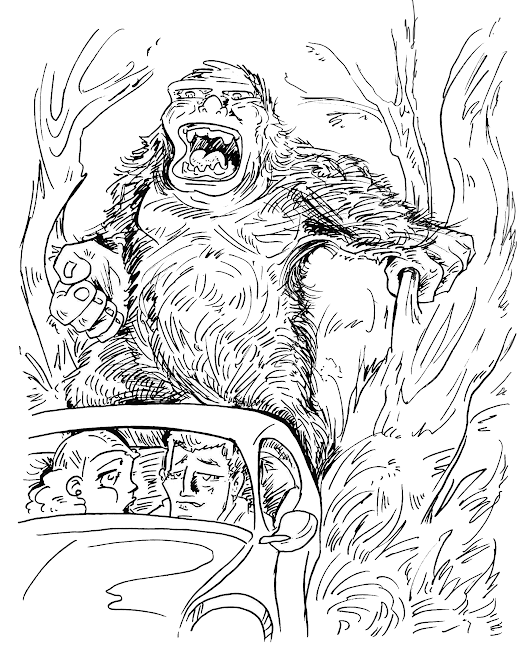
Norwalk, 1968—Author Daniel Cohen’s 1991 book The Encyclopedia of Monsters refers to Orange Eyes as “a central-Ohio variation” of the monster of lovers’ lane, monsters said to hang out in the same out-of-the-way  places that teenagers and young lovers tend to park. He wrote that Orange Eyes was 11-feet tall, completely orange and supposedly indestructible, frightened lovers having “stabbed, shot and driven over the creature to no effect.”

Oh, and Orange Eyes obviously had orange eyes. 

In 1968, the Norwalk Reflector ran an article headlined “‘Orange Eyes’ Mystery Solved.”

I won’t spoil the ending for you here—obviously you’ll want to read all about Orange Eyes in the pages of Monsters of Ohio first—but the solution to the mystery was apparently a simple but surprisingly effective hoax, with rumors filling in the monster behind the orange glow of its eyes.

The article pointing out that Orange Eyes was a hoax obviously didn’t dispel the legend though, as Cohen’s book was published almost 24  years after that article, and the monster later appeared in other books like W. Haden Blackman’s 1998 Field Guide To North American Monsters, Scott Weidensaul’s 2002 book The Ghost With Trembling Wings and, of course, my own book. 

Even when a monster is proven—or perhaps “proven”—to be a hoax, it can live on if its story is compelling enough. 

Illustration by Janie Walland

Meet the Monsters: The Crosswick Monster

Crosswick, 1882—The Crosswick Monster is known from a single but extremely dramatic story from 1882,  and it  takes its name from the small town it was said to appear in, near Waynesville, on the banks of the Miami River in Warren County.

A pair of boys, aged 11 and 13, were fishing by a small creek when they saw the monster rushing at them. It grabbed the 13-year-old in its arms, and ran with him to a large sycamore tree, where it crawled into a hole. The boys’ screams alerted some men working nearby, and soon a small army of 60 was raised to attack the tree with axes. As they worked, the monster emerged, dropped its prey and ran “like a racehorse” across the creek, up a small hill, over a fence and a mile or so north, where it reached a hole in a large hill under a heavy ledge of rocks.

What’s particularly fascinating about the monster is its description. It was described as having various reptilian characteristics, and was said to be 30-40 feet long, but it is never once referred to as a dinosaur of any kind, but instead as a snake with arms and legs.

The word “dinosaur” was itself still a relatively new term back then—it was coined in 1841 by Sir Richard Owen—and yet that really seems to be what is being described throughout, with some of the details surprisingly up-to-date in the way we now think dinosaurs behaved,  like it’s great speed and the fact that “it’s propelling power was in its tail”, suggesting that it balanced itself with its tail, rather than  dragging it behind itself, as was the prevailing view of how dinosaurs moved in the late 19th-century.

The tale of the Crosswick Monster comes to us from a 1968 Warren Historical Society pamphlet by Hazel Warren Phillips. It was one of several stories of dinosaur-like monsters surviving well past the time any dinosaurs should be expected to be found in Ohio.

Illustration by Janie Walland