Review: “Unnatural Ohio”

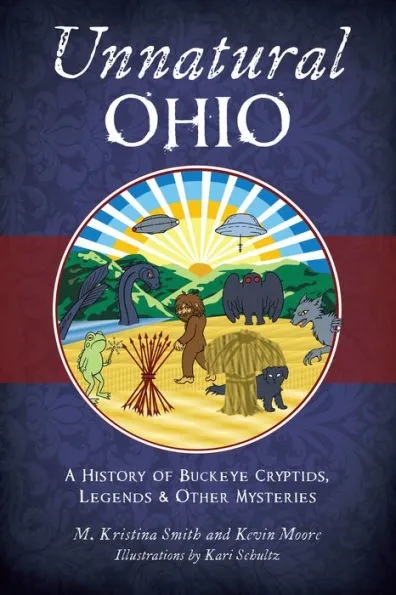
Unnatural OhioA good one-third of Unnatural Ohio: A History of Buckeye Cryptids, Legends & Other Mysteries (The History Press; 2023) should be particularly appealing to those with an interest in the monsters of Ohio. The book, by Rutherford B. Hayes Presidential Library and Museums employees M. Kristina Smith and Kevin Moore, is an expansion and extrapolation of a 2020 special exhibit entitled Ohio: An Unnatural History, and is divided into three sections: Buckeye Cryptids, Ghostly Tales and UFOs and Mysteries of the Sky.

Actually, chances are that most readers will find more than just one section of interest. After all, if you’re interested in one aspect of the paranormal, chances are you’re interested in others…and certainly some blend into each other (As in the case of Mothman, for example, a maybe flesh-and-blood creature that nevertheless intersects with UFO lore). I myself am obviously a monster guy, but I also enjoy reading about UFOs. Ghosts? Not so much. I’m just not a believer.

And, as the writers point out, about “two in every three people reading this will likely believe in at least one of the supernatural Ohio legends we cover,” citing statistics on belief in the paranormal.

In the cryptid section that kicks off the book, the writers focus on six different monsters (all of which are also covered at length in Monsters of Ohio): Bigfoot (they mention the Norwalk Ape, the name “The Grassman” and the Gallipolis Gorilla all in passing), The Loveland Frog, The Defiance Wolfman (which they call “The Dogman of Defiance,” dogmen being more popular than wolfmen at the moment), The Lake Erie Monster, The Melonheads and Mothman.

The writers have a citation heavy, reporterly style that reads with some authority, and there is a very thorough bibliography, allowing the unusually curious to check their work…or to check out more on the subjects (Familiar books like Loren Coleman and company’s 2006 Weird Ohio, James Renner’s 2012 It Came From Ohio, Michael Newton’s 2013 Strange Ohio Monsters and Chad Arment’s 2019 The Historical Bigfoot all appear here).

In addition to relying on newspaper accounts and other books, however, the pair also conduct interviews seemingly everywhere that it’s both beneficial and feasible to do so. Therefore, on the subject of the Wolfman/Dogman of Defiance, they track down a former reporter from the Defiance Crescent-News, which extensively covered the sightings, to ask what he remembers of that time in the 1970s, and cryptozoological writer Lyle Blackburn, about how it compares to other dogman sightings.

This approach is especially welcome when it comes to the Loveland Frog, given how cloudy the story has been over the years, with the main witnesses in the 1972 sighting alternately refusing to talk and changing the account over the years. It remains cloudy, but every fact that can be caught and nailed down seems to be there, including taking the story right up into the modern day, by chronicling the almost-certainly-a-hoax 2016 sighting and the several ways in which Loveland has embraced the legend (Nowhere near as thoroughly as Point Pleasant has embraced the Mothman legend, however; Loveland could certainly use a statue).

As a writer who has covered this same beat in the past, I was most intrigued by their section on the Lake Erie Monster, which they refer to as South Bay Bessie, as it included reports I had never heard of, like one 1912 report in which Kelleys Island residents apparently saw the monster struggling to break through the ice on the frozen lake. There is also more thorough reporting on the former mayor of Milan’s sighting of the monster in the Huron River (this is the one where the monster is described as having both horns and tentacles…both, it seems from the reporting here, on its head).

Part two of the books, that on ghosts, seems to be the slightest, and understandably so: There is so much writing on ghosts in Ohio that it seems all of the stories have been told, re-told and re-re-told. Here they cover “The Elmore Rider,” a headless motorcyclist; Gore Orphanage near Vermillion, which they contend never actually existed, but they track down the stories that lead to the urban legend about it; the legend of Holcomb Woods in east of Bowling Green and a handful of maritime legends, including one of a black dog of ill portent and the supposed Lake Erie Triangle.

Most of these were new to me, although, as I said, I don’t generally pay too much attention to ghost stories, and the books I’ve read on Ohio ghosts I mainly did so looking for monsters tucked in between the ghost stories.

Finally, part three includes a trio of stories that may or may not have something to do with extraterrestrials, all three of which are fairly familiar from the extant literature: The 1966 Portage County UFO chase, in which many police officers saw and gave chase to a UFO; the “WOW!” signal, the OSU “Big Ear” radio telescope’s reception of what seemed to be a “scream” of some sort in the data they regularly received; and the 1973 Coyne UFO incident, in which a helicopter flying from Columbus to Cleveland had a close encounter, being forced to dodge a UFO that seemed intent on ramming them.

Again the pair’s reporterly thoroughness is apparent in these oft-told tales and it is quite welcome. I’ve flirted with the idea of embarking on a book about UFOs in Ohio’s airspace before, but, after reading this section, I’m not so sure it’s even worth doing. For example, after reading their reporting on the Portage County chase, its investigation and its aftermath, I can’t imagine there’s anything left to add.

The book is rather fully illustrated, both by photographs of relevant areas (usually not very compelling images of landscapes and forest paths, sections of road or bridges), and pencil illustrations of the cryptids by artist Kari Schultz (Sadly no image of Mothman, though; he’s represented by a photo of the statue).

Schultz also seems responsible for the cover, in which the great seal of Ohio is crowded with cryptids, including the  black  dog from the ghostly tales section and the specific UFOs from the Portage County and Coyne incidents (I have a t shirt that similarly paired the seal with the paranormal, a much more simple design showing Bigfoot, in the classic “Patty” pose, striding between the bundles of arrows and grains).

One could claim the writers are trying to do too much with their book, tackling three very big subjects as they do, but they basically choose a handful of stories from each of those subjects, and try to unravel the legends into their component stories. It is therefore a good starting point for each of the three subjects and, in some cases, they seem to tell the definitive stories of the stories, like the aforementioned Portage County UFO chase.

The continuing adventures of The Peninsula Python

Are people still telling stories of the Peninsula Python, over 70 years after it fist appeared in and terrorized the village? A few recent-ish mentions of the legendary snake in local books suggest that it’s still being talked about, but in the present, rather than the past, tense.

The tale of the Python was originally told by local reporter Robert Bordner in a 1945 story in The Atlantic with the suspiciously defensive title of “The Peninsula Python: An Absolutely True Story.” As this absolutely true, definitely not hoaxed story goes, in the summer of 1944 a 15- to 18-foot-long snake began slithering around local farms, leaving a trail like an automobile tire that went into and came out of the river, and scaring the heck out of those that saw it, eventually inspiring posses to gather and fruitlessly hunt it. 

As to where the beast came from, the rumor was that a truck containing it had crashed and disgorged its contents in the process. As to where it went, since it was never caught or found dead, the popular theory was that it crawled into a hole somewhere and died as the Ohio winter set in, temperatures plummeting far below those favored by a tropical snake. 

In any case, it, or its children, couldn’t still be around, could they?

Apparently talk of the python is still around, and its since been linked to Helltown, another, more colorful Northeast Ohio legend.

The stories about Helltown are innumerable, and many of them are shared between teenagers visiting or planning to visit the area to explore them for themselves (which they absolutely shouldn’t do). The real story is this. Boston, Ohio was settled in 1806 by New Englanders, and was, by all accounts, a particularly scenic part of the state. So scenic, in fact, that there were those who wanted to turn it into a national park. Finally, in 1974, the federal government began grinding its gears forward on the project. The Ford administration ordered the town to be evacuated and as residents and businesses fled and were bought out, it became a ghost town practically overnight, awaiting its destined demolition and transformation into a park—which never came.

Instead, Boston was left in tact but deserted, the buildings slowly starting to deteriorate as rumors about the queer area began to proliferate There’s was a massive toxic waste spill that drove everyone away (There was a toxic waste spill, but it wasn’t what drove people away).. There’s an empty, haunted school bus there that was scene to a terrible slaughter of its young riders (There was a bus, but no one was murdered on it). There’s a church with upside down crosses that Satanists gather and worship at (There was a church, but there’s no evidence of any Satanists). Terribly deformed people are hiding just out of sight in the many abandoned houses. (Houses? Sure. Mutants? No.) An ax-wielding madman makes his  home there, awaiting curious visitors to make into his latest victims. (You get the idea by now).  

In the ruins of Boston, Helltown was born. 

In her book Myths and Mysteries of Ohio: True Stories of The Unsolved and The Unexplained (Globe Pequot; 2014), Sandra Gurvis discusses Helltown in her chapter “Cuyahoga Valley National Park/ Hell ‘No, We Won’t Go’ Town.”

“Even back in 1945, the alleged escape of python during a carnival truck crash ‘sent posses of armed residents out scouring farm fields for the slithering horror’, states [Brian] Albrecht’s Plain Dealer article,” Gurvis writes in passing at one point. “But to this day, the thirty-foot—and still growing, thanks to all that tasty toxic waste!—’Peninsula Python’ supposedly still wanders the woods and river looking for crunchy granola hikers with a Melon Head chaser.” 

Here we should pause to note the appearance of another Ohio monster, the Melonheads. Gurvis mentions them on the previous page when discussing the toxic waste a hiker supposedly found leaking out of an oil drum in the Cuyahoga Valley National Park that accounted for the emptying out of the area (“Of course, no newspaper or magazine account substantiates this,” she writes of the tale).

Of urban legends regarding the toxic waste, Gurvis writes, “Why not also blame the alleged proliferation of marauding, hydrocephalic, feral ‘Melon Heads’ said to roam the nearby woods of Chardon and Kirtland on the dump as well?” 

Chardon and Kirtland aren’t that close to the park—it’s about a 40-minute drive from Kirtland to Peninsula—although here we can see urban legends bleeding into one another. Just as the Melonheads—or Melon Heads, if you prefer spelling it two words, as Gurvis does—were said to be an isolated, independent community of malformed people, so too were the people in some versions of the Helltown story, where it is known as Mutant Town or Butane Town.

When I first encountered Gurvis’ book, which really does offer a nice, concise retelling of the Helltow story, I was struck by the mention of the Python and Melonheads in a single, not-usually-related-to-either-of-them narrative, and took note of it, but didn’t pursue it any further, as it seemed an aberration to the traditional stories of both monsters.

But then I read Nicky Perry’s Hello Cleveland: Things You Should Know About The Most Unique City in the World (Microcosm Publishing; 2002). Like Gurvis, he also has a chapter on Helltown, and his begins with several scenarios, each a legend about the location, and he too mentions the Python:

…After a massive chemical spill, the citizens of a small nearby town became grossly mutated. Years of inbreeding followed and their offspring still patrol the surrounding forests, feasting on the flesh of anyone foolish enough to wander the woods. The humanoids fear nothing except the Peninsula Python, an enormous snake who was exposed to the chemicals and grew to monstrous proportions. The python is the only thing keeping these deranged creatures in check…

Here again, then, we see the Python linked to nearby Helltown, the suggestion that it is no ordinary python thanks to its exposure to toxic waste (though Perry doesn’t give us an estimated size, as Gurvis did) and even the fact that it eats forest-dwelling monstrous humanoids, creatures that sound not completely unlike the Melonheads

That’s two mentions, then; I’ve heard three makes it a trend. But it is apparently worth keeping an eye and ear out for more stories of the Python in Helltown or as a mutated monster that exists in the present, rather than just an out-of-place animal from a story in the past. Though it started in the 1940s, it would appear the Peninsula Python’s story isn’t quite over yet.

Illustration by Janie Walland

Meet the Monster: The Melonheads

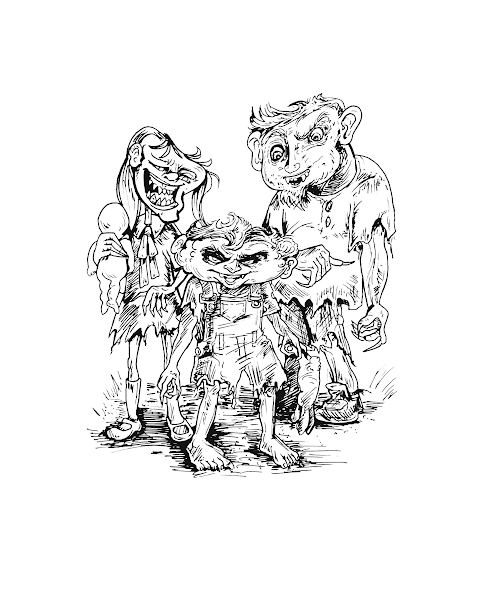
Lake County—There are multiple versions of the story of The Melonheads , but they all seem to involve a character named Dr. Crow in Kirtland, a small town of about 7,000 people in Lake County. Crow is either a malevolent or benevolent figure. In the stories where he’s a good guy, he takes in children suffering from some sort of dramatic macrocephaly—or, um, big-headedness—and cares for them, until a tragic accident sets his house aflame, and he dies in the fire, leaving the children alone. 

In the more popular stories where he’s a bad guy, he acquires children to experiment on—sometimes from the government, sometimes on his own—and he injects their heads with water and performs other cruel experiments that lead to their melon-headed appearances. Again, there’s a fire and he’s killed—sometimes an accident, sometimes the children cause it, but, at any rate, when he’s dead  they escape into the woods.

And they are said to still roam the woods, a nomadic tribe of feral, hunter-gatherers looking for potential victims. Or, in some stories, the Melonheads in the woods are the ghosts of the original children who died in the fire as well. Being an urban legend, there are plenty of variations on almost every aspect of the story.

Though actual, reliable sightings of the Melonheads are rare, driving around the lonely roads said to be their haunts and looking for them has long been a popular pastime for teenagers and young people in Lake County.

Illustration by Janie Walland