Review: “Unnatural Ohio”

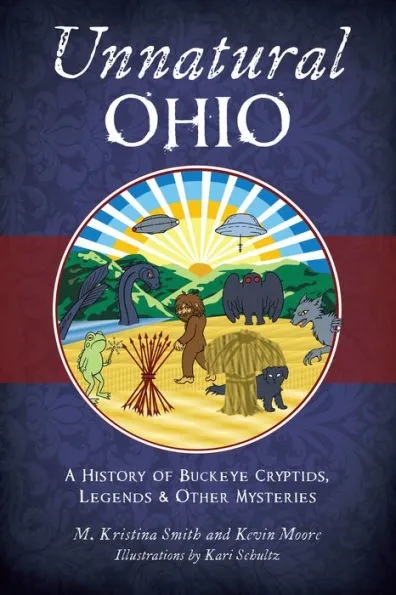
Unnatural OhioA good one-third of Unnatural Ohio: A History of Buckeye Cryptids, Legends & Other Mysteries (The History Press; 2023) should be particularly appealing to those with an interest in the monsters of Ohio. The book, by Rutherford B. Hayes Presidential Library and Museums employees M. Kristina Smith and Kevin Moore, is an expansion and extrapolation of a 2020 special exhibit entitled Ohio: An Unnatural History, and is divided into three sections: Buckeye Cryptids, Ghostly Tales and UFOs and Mysteries of the Sky.

Actually, chances are that most readers will find more than just one section of interest. After all, if you’re interested in one aspect of the paranormal, chances are you’re interested in others…and certainly some blend into each other (As in the case of Mothman, for example, a maybe flesh-and-blood creature that nevertheless intersects with UFO lore). I myself am obviously a monster guy, but I also enjoy reading about UFOs. Ghosts? Not so much. I’m just not a believer.

And, as the writers point out, about “two in every three people reading this will likely believe in at least one of the supernatural Ohio legends we cover,” citing statistics on belief in the paranormal.

In the cryptid section that kicks off the book, the writers focus on six different monsters (all of which are also covered at length in Monsters of Ohio): Bigfoot (they mention the Norwalk Ape, the name “The Grassman” and the Gallipolis Gorilla all in passing), The Loveland Frog, The Defiance Wolfman (which they call “The Dogman of Defiance,” dogmen being more popular than wolfmen at the moment), The Lake Erie Monster, The Melonheads and Mothman.

The writers have a citation heavy, reporterly style that reads with some authority, and there is a very thorough bibliography, allowing the unusually curious to check their work…or to check out more on the subjects (Familiar books like Loren Coleman and company’s 2006 Weird Ohio, James Renner’s 2012 It Came From Ohio, Michael Newton’s 2013 Strange Ohio Monsters and Chad Arment’s 2019 The Historical Bigfoot all appear here).

In addition to relying on newspaper accounts and other books, however, the pair also conduct interviews seemingly everywhere that it’s both beneficial and feasible to do so. Therefore, on the subject of the Wolfman/Dogman of Defiance, they track down a former reporter from the Defiance Crescent-News, which extensively covered the sightings, to ask what he remembers of that time in the 1970s, and cryptozoological writer Lyle Blackburn, about how it compares to other dogman sightings.

This approach is especially welcome when it comes to the Loveland Frog, given how cloudy the story has been over the years, with the main witnesses in the 1972 sighting alternately refusing to talk and changing the account over the years. It remains cloudy, but every fact that can be caught and nailed down seems to be there, including taking the story right up into the modern day, by chronicling the almost-certainly-a-hoax 2016 sighting and the several ways in which Loveland has embraced the legend (Nowhere near as thoroughly as Point Pleasant has embraced the Mothman legend, however; Loveland could certainly use a statue).

As a writer who has covered this same beat in the past, I was most intrigued by their section on the Lake Erie Monster, which they refer to as South Bay Bessie, as it included reports I had never heard of, like one 1912 report in which Kelleys Island residents apparently saw the monster struggling to break through the ice on the frozen lake. There is also more thorough reporting on the former mayor of Milan’s sighting of the monster in the Huron River (this is the one where the monster is described as having both horns and tentacles…both, it seems from the reporting here, on its head).

Part two of the books, that on ghosts, seems to be the slightest, and understandably so: There is so much writing on ghosts in Ohio that it seems all of the stories have been told, re-told and re-re-told. Here they cover “The Elmore Rider,” a headless motorcyclist; Gore Orphanage near Vermillion, which they contend never actually existed, but they track down the stories that lead to the urban legend about it; the legend of Holcomb Woods in east of Bowling Green and a handful of maritime legends, including one of a black dog of ill portent and the supposed Lake Erie Triangle.

Most of these were new to me, although, as I said, I don’t generally pay too much attention to ghost stories, and the books I’ve read on Ohio ghosts I mainly did so looking for monsters tucked in between the ghost stories.

Finally, part three includes a trio of stories that may or may not have something to do with extraterrestrials, all three of which are fairly familiar from the extant literature: The 1966 Portage County UFO chase, in which many police officers saw and gave chase to a UFO; the “WOW!” signal, the OSU “Big Ear” radio telescope’s reception of what seemed to be a “scream” of some sort in the data they regularly received; and the 1973 Coyne UFO incident, in which a helicopter flying from Columbus to Cleveland had a close encounter, being forced to dodge a UFO that seemed intent on ramming them.

Again the pair’s reporterly thoroughness is apparent in these oft-told tales and it is quite welcome. I’ve flirted with the idea of embarking on a book about UFOs in Ohio’s airspace before, but, after reading this section, I’m not so sure it’s even worth doing. For example, after reading their reporting on the Portage County chase, its investigation and its aftermath, I can’t imagine there’s anything left to add.

The book is rather fully illustrated, both by photographs of relevant areas (usually not very compelling images of landscapes and forest paths, sections of road or bridges), and pencil illustrations of the cryptids by artist Kari Schultz (Sadly no image of Mothman, though; he’s represented by a photo of the statue).

Schultz also seems responsible for the cover, in which the great seal of Ohio is crowded with cryptids, including the  black  dog from the ghostly tales section and the specific UFOs from the Portage County and Coyne incidents (I have a t shirt that similarly paired the seal with the paranormal, a much more simple design showing Bigfoot, in the classic “Patty” pose, striding between the bundles of arrows and grains).

One could claim the writers are trying to do too much with their book, tackling three very big subjects as they do, but they basically choose a handful of stories from each of those subjects, and try to unravel the legends into their component stories. It is therefore a good starting point for each of the three subjects and, in some cases, they seem to tell the definitive stories of the stories, like the aforementioned Portage County UFO chase.
Briefly on The Mothman Festival

I visited Point Pleasant, West Virginia for the second time this past weekend. The first time I was there was, of course, to visit the Mothman Museum and statue. This time I was there for the Mothman Festival, an event that was making its return after a few years’ worth of a covid-related hiatus. (If you’ve never been but plan to go some day, I’d recommend visiting the museum sometime other than during the festival, when the lines to get in and to take selfies with the statue were hundreds deep).  

I was not prepared for what a big event it was. It officially started at 10 a.m. on Saturday morning., but by 9:30 parking was difficult and there were sizable crowds and lines outside the museum, for the statue, for the tickets to the hayride and for the local coffee shop; when I left around 2 p.m., it was difficult even walking, as the crowd was literally shoulder-to-shoulder.

The highlight for me were the guest speakers, of which I unfortunately only saw three. When I got up and left my seat to stretch my legs after those first three, I noticed another massive line, this one to get in to see the speakers, apparently there to see Lyle Blackburn. There was no hope of finding a seat again after I abandoned mine then, so I missed Blackburn and Ken Gerhard (whose 2007 book Big Bird!: Modern Sightings of Flying Monsters  I read and was one of the sources I consulted for my own Monsters of Ohio). (The complete schedule of speakers is here.)

The first speaker of the day was Mark Muncy, author of a series of book about the paranormal in his home state of Florida—Eerie Florida, Creepy Florida and Freaky Florida—as well as a book I hope to get to soon, Eerie Appalachia (Though he lives in Florida and has made a career of writing about it, Muncy originally hails from Kentucky.)

As the room where the guest speakers were speaking slowly filled up, Muncy bantered with the crowd and talked about some Florida monsters and told the tale of Robert the Doll, a weird, haunted doll that now makes its home at a museum in the Florida Keys. 

When his talk began in earnest, he focused on more local monsters, from Kentucky, West Virginia and even Ohio. The first of these is one he called “his” monster, one he actually caught a glimpse of as a child. Named The Bench-Leg of Goeble Ridge, the creature had the head of a human being, though one that was somewhat deformed and glowed, and the body of a large cat or cow. And, as its name implies, it also had a wooden leg. (Muncy wrote more about his encounter, and the legendary origins of the Bench-Leg, here.)

As for Ohio, Muncy discussed The Ohio Grassman, a term he used to refer to Ohio’s Bigfoots in general, rather than a particular Bigfoot from the Akron area, noting that all of the witnesses he has talked to referred to the Grassman as having “rock star hair.” He also mentioned “Old Orange Eyes” in passing, calling him the king of the Ohio Grassmen.

He also mentioned The Loveland Frogmen in passing—literally, “You all know the Loveland Frogmen?”; it was weird for me being in a crowd where monster lore is such common knowledge—to discuss another weird story about Loveland, the Chateau Laroche. Among the ghosts supposedly attached to the castle is a gargoyle-like creature. 

Muncy was followed by Zach Bales, author of the 2020 book The Bigfooter’s Altas (as well as The UFO Chaser’s Atlas, The Amateur’s Guide to Ghost Hunting and The Expert’s Guide to Ghost Hunting). An English teacher from Kentucky, Bales spends his summers road-tripping with his wife to investigate the paranormal, from ghosts to Bigfoot, collecting materials for the museum they’re setting up in their hometown, The Nightmare Gallery

The heart of Bales’ presentation was a rather intense story about his own encounter with Bigfoot, or the Green River Monster, as it’s called in his home state (at the beginning of his presentation, he ran through the various names Bigfoot is known by in various states, beginning with the Grassman in Ohio). 

He also discussed trail cameras, one of the more promising tools in the Bigfoot hunter’s arsenal, and why he thinks it is that no one has yet caught a good image of Bigfoot on one. In short, he puts it down to the observer’s effect, and that the act of looking for Bigfoot may alter its behavior in a way that makes it harder to find, and certain aspects of the cameras themselves may frighten wildlife away.

The final talk I saw was that of Nick Redfern, the UK author with a sizable bibliography (Monster Files, The Bigfoot Book and Monsters of The Deep being among those of his I’ve read). The subject was that of flying monsters in the U.K., which included the Cornwall Owlman, a griffin and pteradons, although he also talked a bit about Bigfoot and the Loch Ness Monster and even Slenderman.

His thesis was a criticism of cryptozoology in general, as he disagrees with the notion that crytpids are flesh-and-blood animals yet to be recognized by science—that Bigfoot is merely a huge undiscovered ape making its home in the continental United States, for example—but instead that there is a connection between  human beings. In some cases he seems to put the monster appearances down to the work of human magicians, as he noted Aleister Crowley’s house near Loch Ness in connection to an increase in Nessie’s sightings (Redfern has written a book on the Loch Ness Monster, entitled Nessie!: Exploring the Supernatural Origins of the Loch Ness Monster), and others to the principle that people see what they want to see. 

Thus people see creatures like the Owlman or Mothman or Slenderman because they are really there, but they are there as tulpas or thought-forms, rather than as yet-to-be-discovered animals. 

I hope to return to the festival next year, perhaps as a vendor (I can’t think of any other event within driving distance where one will find thousands of people interested in cryptids like Mothman, who has a chapter of his own in my book).

If I return as a visitor though, I’ll know better than to abandon my seat at any point once the guest speakers start!

Meet the Monsters: Bighoot

Highland County, 1982-1983—Provided that all the people who said they saw Mothman in the Ohio River Valley in 1966-1967 had really seen some sort of flesh and blood creature, could it be that what they were seeing was some sort of undiscovered species of giant, monstrous owl?

That was a theory put forward by the late cryptozoologist and writer Mark Hall, who in his 2004 book Thunderbirds!: America’s Living Legends of Giant Birds (Cosimo Classics; 2004) noted the prevalence of stories of giant birds and owl-like creatures in the Ohio River Valley, of which Mothman might have only been a more recent example.

There was also a Birdman, said to be a giant red bird with the head of a man that, like Mothman, also made a habit of chasing cars. And there were Native American legends about wicked supernatural creatures called “Flying Heads” which were just what they sounded like—giant, flying heads with claws attached. 

Hall thought a large owl could account for these various descriptions as well as the stranger reports of Mothman’s figure; which claimed it had no head, but eyes embedded in its chest. Given an owl’s small round head that seems to sit right atop its round-ish body, as if it had no neck, couldn’t an owl look a little like a large flying human head, or a perhaps a headless winged figure? Especially in the dark, and while in motion?

Owls also, incidentally, give off red eye-shine when light hits the membranes in the back of their eyes in the dark, and Mothman’s most striking feature was, of course, shining red eyes.

Now, how big an owl are we talking about here? After all, Mothman was said to be man-sized and have a ten-foot-wingspan.

Well, we could be talking about a very large owl indeed.

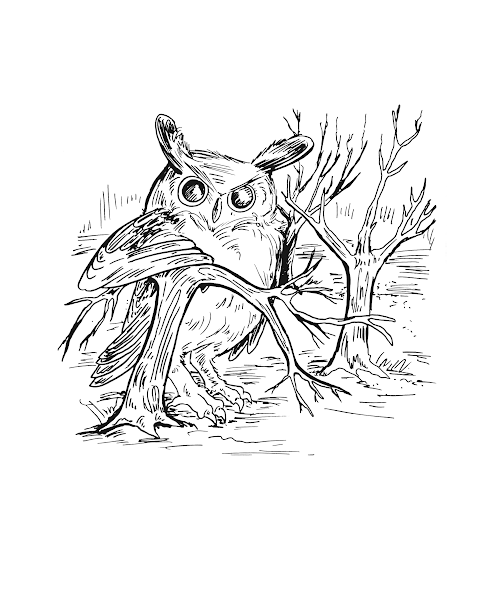
Hall recorded a pair of sightings by a single woman a year apart, in 1982 and 1983, at Rocky Fork Lake park in Highland County in southwest Ohio. In the first sighting, she said she saw what she thought was a  tree start to move…until she realized, once it flexed its small airplane-sized wings, that it was actually a giant owl camouflaged as a dead tree. On the second instance, she noticed that it had huge, yellow legs with three toes on each foot.

Hall called this giant owl “Bighoot,” which didn’t prove too terribly popular among his fellow cryptozoologists, being a bit too cute a name. 

Illustration by Janie Walland

Meet the Monsters: Mothman

Ohio River Valley, 1966-1967: You have undoubtedly heard of The Mothman, one of the most famous cryptids in the world. You’ve also probably heard that the mysterious creature hails from Point Pleasant, West Virginia, where it was seen over 100 times in a 13-month period between 1966-1967, before the Silver Bridge collapsed into the Ohio River, killing 46 people. After that tragedy, Mothman sightings stopped as suddenly as they began. 

So what’s Mothman doing on a blog—and in a book—on Ohio monsters? Well, the Silver Bridge connected West Virginia to Ohio, and monsters, like all animals, aren’t confined by state borders: The Mothman was reportedly seen at least three times in the state of Ohio during its year long reign of terror and high strangeness in the Ohio River Valley.

In the first instance, a gray, man-sized bird-like creature with a 10-foot wingspan chased the car of a 17-year-old boy on the highway along the river.

In the second, four women driving at night found their car “buzzed” by a huge bird with a brown and silvery body and large red eyes.

And  in the third and final instance, a pair of women driving late at night saw a large, white creature with curving, 10-foot wings and long hair in the road in front of them that  then soared straight up into the sky.

No one really knows what exactly people in the Ohio River Valley were seeing that year, but theories abound: Was it a demon? An extraterrestrial? An ultra-terrestrial? A mutant bird? A man-made construction? The result of a curse?

One of theory was that many Mothman sightings were the result of people mistaking owls for bigger, scarier creatures. And, another, related theory is that, if we can be permitted to replace one species of monster with another, that the creatures people were seeing were actually some sort of giant, undiscovered monstrous owl. But more on that next week…

Illustration by Janie Walland