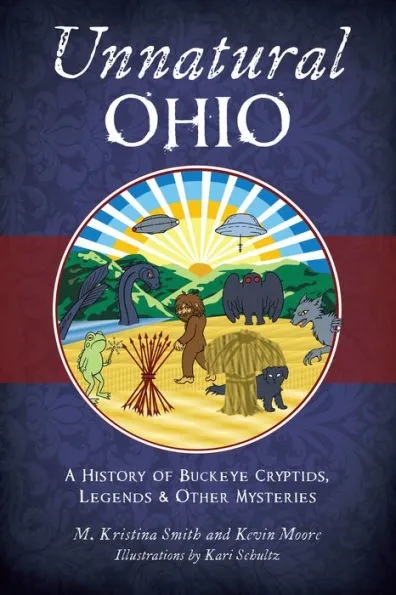
 A good one-third of Unnatural Ohio: A History of Buckeye Cryptids, Legends & Other Mysteries (The History Press; 2023) should be particularly appealing to those with an interest in the monsters of Ohio. The book, by Rutherford B. Hayes Presidential Library and Museums employees M. Kristina Smith and Kevin Moore, is an expansion and extrapolation of a 2020 special exhibit entitled Ohio: An Unnatural History, and is divided into three sections: Buckeye Cryptids, Ghostly Tales and UFOs and Mysteries of the Sky.
Actually, chances are that most readers will find more than just one section of interest. After all, if you’re interested in one aspect of the paranormal, chances are you’re interested in others…and certainly some blend into each other (As in the case of Mothman, for example, a maybe flesh-and-blood creature that nevertheless intersects with UFO lore). I myself am obviously a monster guy, but I also enjoy reading about UFOs. Ghosts? Not so much. I’m just not a believer.
And, as the writers point out, about “two in every three people reading this will likely believe in at least one of the supernatural Ohio legends we cover,” citing statistics on belief in the paranormal.
In the cryptid section that kicks off the book, the writers focus on six different monsters (all of which are also covered at length in Monsters of Ohio): Bigfoot (they mention the Norwalk Ape, the name “The Grassman” and the Gallipolis Gorilla all in passing), The Loveland Frog, The Defiance Wolfman (which they call “The Dogman of Defiance,” dogmen being more popular than wolfmen at the moment), The Lake Erie Monster, The Melonheads and Mothman.
The writers have a citation heavy, reporterly style that reads with some authority, and there is a very thorough bibliography, allowing the unusually curious to check their work…or to check out more on the subjects (Familiar books like Loren Coleman and company’s 2006 Weird Ohio, James Renner’s 2012 It Came From Ohio, Michael Newton’s 2013 Strange Ohio Monsters and Chad Arment’s 2019 The Historical Bigfoot all appear here).
In addition to relying on newspaper accounts and other books, however, the pair also conduct interviews seemingly everywhere that it’s both beneficial and feasible to do so. Therefore, on the subject of the Wolfman/Dogman of Defiance, they track down a former reporter from the Defiance Crescent-News, which extensively covered the sightings, to ask what he remembers of that time in the 1970s, and cryptozoological writer Lyle Blackburn, about how it compares to other dogman sightings.
This approach is especially welcome when it comes to the Loveland Frog, given how cloudy the story has been over the years, with the main witnesses in the 1972 sighting alternately refusing to talk and changing the account over the years. It remains cloudy, but every fact that can be caught and nailed down seems to be there, including taking the story right up into the modern day, by chronicling the almost-certainly-a-hoax 2016 sighting and the several ways in which Loveland has embraced the legend (Nowhere near as thoroughly as Point Pleasant has embraced the Mothman legend, however; Loveland could certainly use a statue).
As a writer who has covered this same beat in the past, I was most intrigued by their section on the Lake Erie Monster, which they refer to as South Bay Bessie, as it included reports I had never heard of, like one 1912 report in which Kelleys Island residents apparently saw the monster struggling to break through the ice on the frozen lake. There is also more thorough reporting on the former mayor of Milan’s sighting of the monster in the Huron River (this is the one where the monster is described as having both horns and tentacles…both, it seems from the reporting here, on its head).
Part two of the books, that on ghosts, seems to be the slightest, and understandably so: There is so much writing on ghosts in Ohio that it seems all of the stories have been told, re-told and re-re-told. Here they cover “The Elmore Rider,” a headless motorcyclist; Gore Orphanage near Vermillion, which they contend never actually existed, but they track down the stories that lead to the urban legend about it; the legend of Holcomb Woods in east of Bowling Green and a handful of maritime legends, including one of a black dog of ill portent and the supposed Lake Erie Triangle.
Most of these were new to me, although, as I said, I don’t generally pay too much attention to ghost stories, and the books I’ve read on Ohio ghosts I mainly did so looking for monsters tucked in between the ghost stories.
Finally, part three includes a trio of stories that may or may not have something to do with extraterrestrials, all three of which are fairly familiar from the extant literature: The 1966 Portage County UFO chase, in which many police officers saw and gave chase to a UFO; the “WOW!” signal, the OSU “Big Ear” radio telescope’s reception of what seemed to be a “scream” of some sort in the data they regularly received; and the 1973 Coyne UFO incident, in which a helicopter flying from Columbus to Cleveland had a close encounter, being forced to dodge a UFO that seemed intent on ramming them.
Again the pair’s reporterly thoroughness is apparent in these oft-told tales and it is quite welcome. I’ve flirted with the idea of embarking on a book about UFOs in Ohio’s airspace before, but, after reading this section, I’m not so sure it’s even worth doing. For example, after reading their reporting on the Portage County chase, its investigation and its aftermath, I can’t imagine there’s anything left to add.
The book is rather fully illustrated, both by photographs of relevant areas (usually not very compelling images of landscapes and forest paths, sections of road or bridges), and pencil illustrations of the cryptids by artist Kari Schultz (Sadly no image of Mothman, though; he’s represented by a photo of the statue).
Schultz also seems responsible for the cover, in which the great seal of Ohio is crowded with cryptids, including the black dog from the ghostly tales section and the specific UFOs from the Portage County and Coyne incidents (I have a t shirt that similarly paired the seal with the paranormal, a much more simple design showing Bigfoot, in the classic “Patty” pose, striding between the bundles of arrows and grains).
One could claim the writers are trying to do too much with their book, tackling three very big subjects as they do, but they basically choose a handful of stories from each of those subjects, and try to unravel the legends into their component stories. It is therefore a good starting point for each of the three subjects and, in some cases, they seem to tell the definitive stories of the stories, like the aforementioned Portage County UFO chase.


 Monsters of Ohio