Other Lake Erie Monsters

When one hears the words “Lake Erie Monster,” one likely immediately thinks of the large, serpentine creature that has been so often sighted, and is thus widely believed to make its home in Lake Erie. But there are plenty of other Lake Erie Monsters too. For example…

The beer: Cleveland-based Great Lakes Brewing Company describes its seasonally available Lake Erie Monster Imperial IPA as a “South Bay Bessie-inspired brew” that “launches an intense hop attack amid torrid tropical fruit flavors” and pairs well with “steak, aged cheeses and tall tales.”  The art on the can features a scary-looking green sea serpent rearing out of the lake.

The  sandwich: Cleveland-based restaurant chain Melt Bar and Grilled’s Lake Erie Monster is a Guinness-battered fillet of walleye, perch or cod, with American cheese and a jalapeño tartar sauce between two thick slices of toast. Like all of Melt’s sandwiches, the portion-size is truly monstrous. The sandwich is part of Melt’s rotating line-up, but you can always attempt your own with the recipes published in Field & Stream or The Washington Post (Me, I’m vegetarian, so I’ve never tried it, but I’d happily recommend the restaurant to anyone). 

The ice cream: The Sandusky-based Toft’s Dairy has been in business for over 120-years now, and one of its many offerings is an ice cream called Lake Erie Cookie Island Monster, which starts with a base of blue cake batter ice cream and mixes in chunks of cookie dough, chocolate chips and chocolate cookies and cream. The artwork on the half-gallon container features a friendly-looking black serpent shaped creature with fins on its humped back, making its way through a moonlit lake. If you can’t find it in the store, there’s always the Toft’s Dairy parlors, in Sandusky, Port Clinton and inside Cedar Point. Hitting one of them to taste this concoction is on my to-do list for next summer.

The milkshake :The Fairport  Harbor Creamery in Fairport Harbor offers a Lake Erie Monster among their boozy milkshakes, consisting of mint ice cream infused with whiskey and Creme de Menthe, along with chocolate sauce and crushed Oreos and topped with whipped cream and a cherry.

The hockey team: The Cleveland Monsters are an American Hockey League team that began life as The Lake Erie Monsters in 2007, their logo featuring a black, finned head and a pair of yellow eyes breaking the surface of the water. They later changed their name to the Cleveland  Monsters, but kept the cool logo. They are currently the top affiliate of the NHL’S Columbus Blue Jackets, and play in downtown Cleveland’s Rocket Mortgage FieldHouse.

The comic book: Cleveland artists J. Kelly and John G.’s quarterly horror anthology The Lake Erie Monster featured a serially-published chapter of their “adaptation” of their pretend movie, also called The Lake Erie Monster, which was originally concieved part of a series of “Ten Imaginary Movie Posters.” Set in 1970s Cleveland, the melodrama featured a scaly fish-man like monster that had more in common with the Charles Mill Lake Monster than the more familiar serpentine image of Bessie. Each issue, hosted by the Cryptkeeper-like character The Commodore, also featured a back-up story.

Meet the Monsters: The Lake Erie Monster

Lake Erie, 1793-Present—Perhaps the most famous Ohio monster is also the one with the longest track record of sightings, going back to at least 1793, when a ship startled a “giant serpent” near the Lake Erie Islands. 

The Lake Erie Monster has been described in a variety of ways, among the wildest of which was in an 1887 report from a pair of brothers who said they found a glowing, 20-30-foot long, fish-like creature with long arms on a beach near Port Clinton and a 1912 report in which the ex-mayor of Milan saw a horned creature with tentacles eat a dog and a groundhog near the banks of the Huron river. 

The more standard picture that emerges of the Lake Erie Monster is something just below the surface and out of sight, something long and snake-like in shape and dark in color, with a head, fins or tail only appearing in the most colorful sightings. This is one reason that skeptics have for believing the monster is really just a series of misidentifications of strange waves or debris floating on or just below the surface of the lake.

The monster has had its champions over the years, however. One of them was the Put-In-Bay Gazette, which ran a joke story about a serpent based on an unusual piece of driftwood and, to their surprise, received dozens of reports from people claiming to have actually seen the monster.

Another big monster booster was the city of Huron, which in September of 1990 took various steps to promote the city by using the monster sightings. This climaxed in a pair of big stories in two quite different publications in the late summer of 1993: A Wall Street Journal cover story about Huron’s efforts to become a monster city, and a Weekly World News cover story, complete with doctored image of a sauropod-like dinosaur attacking a sailboat said to have been taken by a passing airplane pilot, headlined “Lake Erie Monster Sinks Sailboat.”

The monster is sometimes known as Bessie or South Bay Bessie, names that rhyme with “Nessie” being popular for lake monsters, or Lemmy, and extrapolation of the initials for Lake Erie Monster. It’s even been given the scientific name of Obscura eriensis huronii (Roughly, “unknown creature in Lake Erie near Huron”), by Charles

The monster is sometimes known as Bessie or South Bay Bessie, names that rhyme with “Nessie” being popular for lake monsters, or Lemmy, and extrapolation of the initials for Lake Erie Monster. It’s even been given the scientific name of Obscura eriensis huronii (Roughly, “unknown creature in Lake Erie near Huron”), by Charles Herdendorf, a retired Ohio State University biologist enlisted by the city of Huron to give a presentation on the possibility of the creature’s existence.

It should be noted that when Herdendorf assigned the monster its name, he did so with tongue planted firmly in cheek, which is why it’s probably best to keep calling the monster “The Lake Erie Monster”—at least until someone finally catches one, anyway.

Illustration by Janie Walland

Review: “Evergreen Ape: The Story of Bigfoot”

David Norman Lewis’ Evergreen Ape: The Story of Bigfoot (Microcosm Publishing; 2021) is a small book in all ways but one. At 5-by-7-inches, it’s practically pocket-sized, and at just 126 heavily-spaced pages, it’s a quick read that can easily be accomplished in a single sitting. It’s subject matter, however, is big. Lewis tackles not only Bigfoot, but why it is that so many people seem so obsessed with the cryptid, and the fact that throughout human history there has always been a cultural tradition of big hairy wild men helping, hurting or at just living beside us.

Indeed, Lewis writes early in his introductory chapter that “Why the idea of an undiscovered species of ape living in the Northwest wilderness is appealing to so many people is a bigger mystery than whether or not the creature exists.” It’s that mystery he focuses on more so than relitigating arguments about the creatures’ existence as a real flesh-and-blood species of aniimal.

In eight fleet chapters—the ninth is a “Bigfoot Hiking Guide” suggesting a quartet of West Coast routes that will be accessible to Lewis’ Pacific Northwest target audience—the writer covers some well-trod ground, but he doesn’t dwell too long on the specifics of various cases or areas of argumentation. Rather, he seems most interested in the ideas that Bigfoot suggests, and what thinking about, and looking for, Bigfoot reveals about humanity in general…but  particularly modern humanity. And, particular among that group, white Baby Boomers, the audience that Bigfoot seems to appeal to the most (“Dr. Robert Michael Pyle, an American lepidopterist who attended a similar Bigfoot convention, famously noted about the attendees ‘these guys don’t want to find Bigfoot—they want to be Bigfoot,” Lewis writes). 

His conclusions tend to be pretty interesting, making this a book a rather compelling entry into a crowded genre.

Lewis covers, at least in passing, the 1924 Ape Canyon incident, Albert Ostman’s abduction story, the careers of Rene Dahinden and Grover Krantz, the case of “Cripple Foot” and the Patterson-Gimlin film controversy, but in all cases he does so in such a way that the stories won’t feel tedious or repetitive, no matter how many other books you’ve read that have covered the same subjects.

Lewis also discusses the story of John Tornow, who escaped an Oregon insane asylum and hiked back to the Olympic Peninsula, where he took the woods and became semi-feral, murdering anyone who came into the woods to try and drag him out…eventually becoming something of a folk hero, or at least folk character, despite all the murders. It’s a story that will have particular resonance for readers in Portland-based publisher Microcosm’s region of the country, an audience Lewis’ book seems to keep focus on, although it’s worth noting the proceedings should prove of interest to anyone interested in Bigfoot, whatever part of the country—heck, whatever country—they live in.

He also tells the story of several real apes that definitely lived in the area, Bobo and Kiki, gorillas at the Seattle zoo, and he addresses at some length  the pre-Bigfoot concept of the “Wild Man” in America among white folks (that is, the idea that a man could become bestial by renouncing society and living in the woods like an animal), the cultural traditions of wild man as symbolic  helpmate and adversary in European as well as in Native American traditions (and the ancient Middle East, if you want to count the discussion of Gilgamesh) and 18th century philosopher Jean-Jacques Rousseau’s thinking on the “noble savage.”

The conclusions he comes to are not entirely unique.

The interest in Bigfoot is, essentially, an interest in nature and, more specifically, a need or desire to reconnect to nature, or the idea of nature, even if a bridge in the form of a mythic animal-human hybrid must be invented to get there. Even the way people regard these “wild men” shift over the years, as Lewis points out the 19th century wild men weren’t regarded by white people in America as a separate species, but simply one of their own that had gone wild, and could be tamed and returned to civilization. Not so after the frontier had been closed and conquered, and nature essentially tamed. Then wild men seemed to become a definitive “other”, one that people, as the late Krantz articulates in Lewis’ chapter on him, seemed to  have strong opinions over the existence of or non-existence of, despite knowing very little about the subject. 

Bigfoot gradually began to represent an idealized, unconquerable, forever wild version of nature, one that stubbornly—thankfully—continues to exist, no matter how out of whack the ratio civilization and the wild grew over the course of the 19th and 20th century and into the 21st century. 

Personally, I don’t know if we’ll ever actually find Bigfoot, or any sort of North American ape, alive or extinct, but I remain fascinated by the search, and by stories of that search, like that told in Lewis’ engaging and insightful little volume.  

*********************

I was a little surprised to find that Lewis singles out Dr. Robert Michal Pyle’s 1997 Where Bigfoot Walks: Crossing The Dark Divide for derision, calling it “unreadably flowery” and saying that “Most of his book on Bigfoot is just him jerking off about the beauty of trees.”

I was surprised because it seems an uncharacteristically harsh assessment from Lewis, whose argumentation throughout the rest of the short book is pretty even-tempered, and it is the only instance where he really goes out of his way to take something down (although I suppose he gets close in his discussion of Fred Beck’s I Fought The Apemen of Mount St. Helens). 

And I was surprised because I liked Pyle’s book. In fact, if you were to ask me to suggest three Bigfoot books off the top of my head, chances are that would be one of them (The others? John Zada’s 2020 In the Valleys of the Nobel Beyond: In Search of The Sasquatch and Joshua Blu Buhs’ 2009 Bigfoot: The Life and Times of a Legend. Or maybe Loren Coleman’s 2003 Bigfoot! The True Story of Apes in America. Although I might also recommend Coleman and Patrick Huyghe’s 2006 The Field Guide to Bigfoot and Other Mystery Primates or T.S. Mart and Mel Cabre’s 2020 The Legend of Bigfoot: Leaving His Mark on the World, depending on who’s asking for the recommendation and what their level of interest is).

Granted, it’s been a good ten years since I read Pyle’s book. Maybe I would like it less if I re-read it today, especially with Lewis’ criticism fresh in my mind…?

*********************

The other moment in Lewis’ book that surprised me was his introduction’s passage about Bigfoot movies, which he makes in relation to Seattle’s Scarecrow Video, “America’s largest surviving video rental store” which also happens to have a Bigfoot section.

Lewis writes that “just by looking at the covers it is clear that somebody will find Bigfoot before anybody makes a watchable movie about them.”

Now, I’ve seen a lot of Bigfoot movies, and yes, a lot of them have been pretty terrible, a few of them almost unwatchably so, although I persevered through until the credits of even the worst of them (of which I think may be 1983’s Night of The Demon). But while maybe there’s no masterpiece of filmmaking that includes Bigfoot in its plot, there are some damn well-made films. The two that leap most immediately to mind are 2006’s Abominable (which Lewis mentions in a different context later in the book), a sort of Rear Window remake mixed into a Bigfoot horror film, and 2013’s Willow Creek, a rare post-Blair Witch found footage film that I found devastatingly effective.

I’d be happy to hear any suggestions of great, or even just pretty damn good, Bigfoot movies, though. 

As to why Bigfoot movies in general are no good, Lewis has an interesting theory:

Bigfoot is hard to dramatize because he doesn’t do anything. Aliens abduct farmers, vampires suck blood, the chupacabra sucks goat blood, the Mongolian Death Worm electrocutes people, but all Bigfoot does is exist, and existing is all he has to do for people to devote their lives to looking for him.

Well, he might not even need to actually exist, of course, for people to be fascinated with him. 
Meet the Monsters: The Loveland Frogs

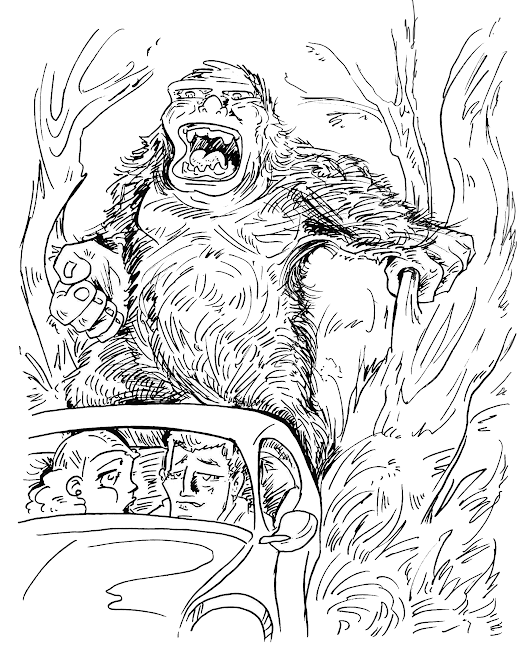
Loveland, 1972—The Loveland Frogs are among the more famous of Ohio’s cryptids, as witnesses have reported ape-men of various shapes and descriptions all over the world, and even lizard-men are fairly common in cryptozoology, but frog-men? Those seem to be unique to Loveland, a small town that’s part of the Greater Cincinnati area. 

Interestingly, in 1955 there were multiple reports of small, oddly-shaped men with vaguely frog-like faces in and around Loveland, stories that are usually associated with ufology rather than cryptozoology.

The story of the Frogs proper occurs in 1972, when a pair of policemen each said they encountered a humanoid frog.

On March 3, 1972, a policeman caught sight of an upright, four-foot-tall, leathery-skinned, frog-faced creature in his car’s headlights while driving  towards Loveland. The officer watched as the creature ran to the side of the road, hopped the guardrail and quickly ran down the embankment and disappeared into the water of the Little Miami River. 

Two weeks later, a second officer saw a prone figure in his headlights that he at first took to be a wounded animal. He stopped his car to investigate, got out and approached the figure…and then realized it was a large, frog-like creature. 

The figure jumped up into a crouched position and, as in the previous sighting by the previous officer, it ran to and vaulted the nearest guardrail. The officer fired a few shots at it, to no avail. 

The second officer later said that what he saw was an ordinary iguana, and that he shot at it in order to produce a body and end the speculation of what the first officer saw. But a good monster story will always outlive a solution that could potentially dismiss it.

Illustration by Janie Walland

Review: “Mystery Stalks The Prairie”

Mystery Stalks The Prairie (Riverbend Publishing; 2021) was originally published in 1976, and the fact that it is being republished in 2021 should speak to the interest it generated over the decades, as well as the influence it has had on discussion of its subject matter: Cattle mutilations. A collaboration between Keith Wolverton, who was then a sheriff’s deputy in Cascade County, Montana, and writer Roberta Donovan, it’s a book-length exploration of Wolverton and his fellow officers’ investigation of a series of cattle mutilations in and around his county in the 1970s. 

As to what, exactly, was responsible for the mutilations, Wolverton did not, in the original book, come to any conclusions, but he was open to any and all possible explanations, no matter how out there those explanations might seem. These included that perhaps some sort of devil-worshipping cult was killing cattle and taking pieces of them to use in occult rituals, that perhaps people were using helicopters to capture and cut-up cows for even more mysterious reasons and, of course, that it was all the work of aliens, or whoever it was exactly that rides around in UFOs. 

There was— perhaps coincidentally, perhaps not—a lot of UFO activity in the area at the time, and entire chapters are devoted to Wolverton and his fellow officers chasing down UFOs. And he meant, I should perhaps note, UFOs in the in the truest sense of the term—rather than flying saucers or strange vehicles, the flying objects were completely unidentified. Sometimes they were no more than mysterious lights in the sky, other times they seemed to be helicopters or other conventional aircraft, but not ones that anyone in a position to know could identify. 

The 2021 publication includes the entire 1976 original book, plus several new features. There’s a new introduction by Montana UFOs and Extraterrestrials author Joan Bird (which includes the revelation of a 1947 cattle mutilation on a Blackfeet reservation in Montana, one linked pretty directly to extraterrestrials), a new epilogue written by Wolverton in 2019, and the transcript of a 2016 interview of Wolverton and Pete Howard, a retired sheriff of Teton County in Montana who, like Wolverton, was involved in the original investigation.

So, as interesting as UFOs may be, what makes this a book to discuss on a blog devoted to monsters and cryptozoology? Well, among all the other strangeness Wolverton and company were investigating in the seventies, there were also sightings of large, hairy humanoid creatures of the Bigfoot variety—although, curiously enough, in the 1976 text, Wolverton never uses the word “Bigfoot: or “Sasquatch,” but continually refers to them as “the creature” or “creatures.” 

The eleventh chapter of the book is “Hairy Creatures, Eight Feet Tall” and, begins:

Law officers have been unable so far to find an explanation for the sequence in which the strange events have occurred.

First there was the rash of cattle mutilations, then the many sightings of unidentified helicopters, followed by numerous UFO sightings and—more recently—the reports of people who saw one or more strange hairy creatures that walked upright like a man.

There was overlapping, but one type of activity seemed to decline as another started.

There was a December 1974 sighting by a man who said he saw a creature between seven and eight feet tall that looked like a grizzly bear; he fired his gun at it three times to no effect, and then retreated to his car as it kept coming toward him.

There was a December 26, 1975 sighting by two junior high girls of a creature between seven and seven and a half feet tall and twice as wide as a man, with a face that was “dark and awful looking and not like a human’s.”

One of the girls’ father said he heard “a sound that he could only describe as like a human dying an agonizing death” that he attributed to one of the creatures. Such cries were heard by others in the area, and was among the circumstantial evidence relating to the creatures that Wolverton found when he investigated.

The most dramatic sighting was that of a 16-year-old boy who saw a tall, hairy creature walking in the pasture outside of his home on the morning of April 4, 1976. Like many Bigfoot sightings, this creature appeared not to have a neck, and was further described as being entirely covered with dark hair about an inch long, save for his face. The boy thought the creature, which walked smoothly with long strides and didn’t seem to bend its knees much, was about eight feet tall. It met another creature. The witness provided sketches of the creature, which are reproduced in the book.

There is a bit of follow-up regarding the creatures in the next chapter, as Wolverton wrote of his interaction with groups studying them in Pennsylvania and New Jersey. The unnamed spokesmen for one of the groups that Wolverton spoke to at the time told him there was “no doubt the things are real” and that there is some sort of link between the cattle mutilations and the “strange hairy creatures.”

Wolverton further reported that there may be a link between the creatures and UFOs, and notes some ways in which the creatures don’t behave like real flesh and blood animals, like their being seemingly impervious to gunfire, disappearing suddenly, having glowing eyes and so on. 

“One theory being studied by those at the Pennsylvania center is that the creatures may be a psychic phenomenon, visible to some and not to others and possibly non-physical,” Wolverton wrote.

In the context of the book, however, they are just one more sort of strangeness that seemed to plague Wolverton’s beat, and which he investigated but could come to no conclusions regarding.

In the 2019 epilogue to the updated edition that Wolverton wrote, he notes some post-retirement investigations he conducted, at which time he seemed more open to embracing more outre explanations for some of the mysteries he wrote about in the 1970s. 

“After retiring, I knew I was never going to solve the cattle mutilations, so I decided to investigate the possibility of finding Bigfoot,” Wolverton wrote.

He did not, but tells a bit about he and a fellow researcher went on trips to California, Washington, Oregon, British Columbia and Alaska, and talks in detail about some of the investigations, sharing witness reports.

One of particular interest to readers of Monsters of Ohio may be that a man reported finding “a large woven nest among a group of trees” in Alaska, similar, perhaps to the nest Bigfoot investigators found in the Akron area in the 1990s and attributed to the Grassman. 

“The nest appeared to be five feet by four feet,” Wolverton wrote. “It was interesting because it seemed to be woven into an oval shape by grass and twigs.” 

Hair samples found in the nest were tested, and turned out to belong to a bear. That trip concluded Wolverton’s search for Bigfoot, a term he used freely in his 2019 epilogue, even if he seemed to carefully avoid using it in the original text of Mystery Stalks the Prairie.

Because so much of the book reads exactly like what it is—a law enforcement officer uncommitted to a particular theory investigating strange happenings—there’s a certain dryness to the proceedings that might make it a difficult read for some readers, despite the relative brevity of the book. It’s nevertheless an interesting work, mostly because it is the work of an open-minded public servant trying to make some sense out of what seems to be completely senseless. 

Meet The Monsters: Orange Eyes

Norwalk, 1968—Author Daniel Cohen’s 1991 book The Encyclopedia of Monsters refers to Orange Eyes as “a central-Ohio variation” of the monster of lovers’ lane, monsters said to hang out in the same out-of-the-way  places that teenagers and young lovers tend to park. He wrote that Orange Eyes was 11-feet tall, completely orange and supposedly indestructible, frightened lovers having “stabbed, shot and driven over the creature to no effect.”

Oh, and Orange Eyes obviously had orange eyes. 

In 1968, the Norwalk Reflector ran an article headlined “‘Orange Eyes’ Mystery Solved.”

I won’t spoil the ending for you here—obviously you’ll want to read all about Orange Eyes in the pages of Monsters of Ohio first—but the solution to the mystery was apparently a simple but surprisingly effective hoax, with rumors filling in the monster behind the orange glow of its eyes.

The article pointing out that Orange Eyes was a hoax obviously didn’t dispel the legend though, as Cohen’s book was published almost 24  years after that article, and the monster later appeared in other books like W. Haden Blackman’s 1998 Field Guide To North American Monsters, Scott Weidensaul’s 2002 book The Ghost With Trembling Wings and, of course, my own book. 

Even when a monster is proven—or perhaps “proven”—to be a hoax, it can live on if its story is compelling enough. 

Illustration by Janie Walland

Meet the Monsters: The Crosswick Monster

Crosswick, 1882—The Crosswick Monster is known from a single but extremely dramatic story from 1882,  and it  takes its name from the small town it was said to appear in, near Waynesville, on the banks of the Miami River in Warren County.

A pair of boys, aged 11 and 13, were fishing by a small creek when they saw the monster rushing at them. It grabbed the 13-year-old in its arms, and ran with him to a large sycamore tree, where it crawled into a hole. The boys’ screams alerted some men working nearby, and soon a small army of 60 was raised to attack the tree with axes. As they worked, the monster emerged, dropped its prey and ran “like a racehorse” across the creek, up a small hill, over a fence and a mile or so north, where it reached a hole in a large hill under a heavy ledge of rocks.

What’s particularly fascinating about the monster is its description. It was described as having various reptilian characteristics, and was said to be 30-40 feet long, but it is never once referred to as a dinosaur of any kind, but instead as a snake with arms and legs.

The word “dinosaur” was itself still a relatively new term back then—it was coined in 1841 by Sir Richard Owen—and yet that really seems to be what is being described throughout, with some of the details surprisingly up-to-date in the way we now think dinosaurs behaved,  like it’s great speed and the fact that “it’s propelling power was in its tail”, suggesting that it balanced itself with its tail, rather than  dragging it behind itself, as was the prevailing view of how dinosaurs moved in the late 19th-century.

The tale of the Crosswick Monster comes to us from a 1968 Warren Historical Society pamphlet by Hazel Warren Phillips. It was one of several stories of dinosaur-like monsters surviving well past the time any dinosaurs should be expected to be found in Ohio.

Illustration by Janie Walland

Introducing Monsters of Ohio

My new book Monsters of Ohio and is a comprehensive examination of the various creatures of cryptozoology, folklore and urban legend that have been sighted, rumored, hoaxed, reported on or otherwise written about throughout the state of Ohio’s history.

These include well-known monsters of like The Lake Erie Monster, the prehistoric serpent said to patrol the state’s north coast; West Virginia’s famed Mothman, who made several flying forays into southeastern Ohio in the late 1960s; The Loveland Frogmen, the humanoid frogs seen in the Cincinnati suburb in the 1970s; and various versions of Bigfoot-like creatures, including The Grassman, The Minerva Monster, The Norwalks Ape, Richland County’s Big Head and the notorious monster of lovers’ lane, Orange Eyes.  

There are also lesser-known local legends, like the dinosaurian Crosswick Monster that was said to have attacked a boy in Warren County in 1882; The Peninsula Python, the huge, mystery snake that terrorized the Summit County village during the summer of 1944; the Defiance Wolfman, an animal-headed human that set off a wave of hysteria in the northwestern Ohio town 1972; and The Melonheads, huge-headed humanoids said to roam t he woods in Lake and Geauga Counties.  

Monsters of Ohio tackles the tales of thirteen different creatures at some length in its first thirteen chapters, and concludes with a fourteenth chapter devoted to miscellaneous monsters that have appeared in the state at one point or another, but either didn’t stick around long enough to generate a substantial body of lore or that might be shared with other neighboring states.

The book is set for a November 10th release.